
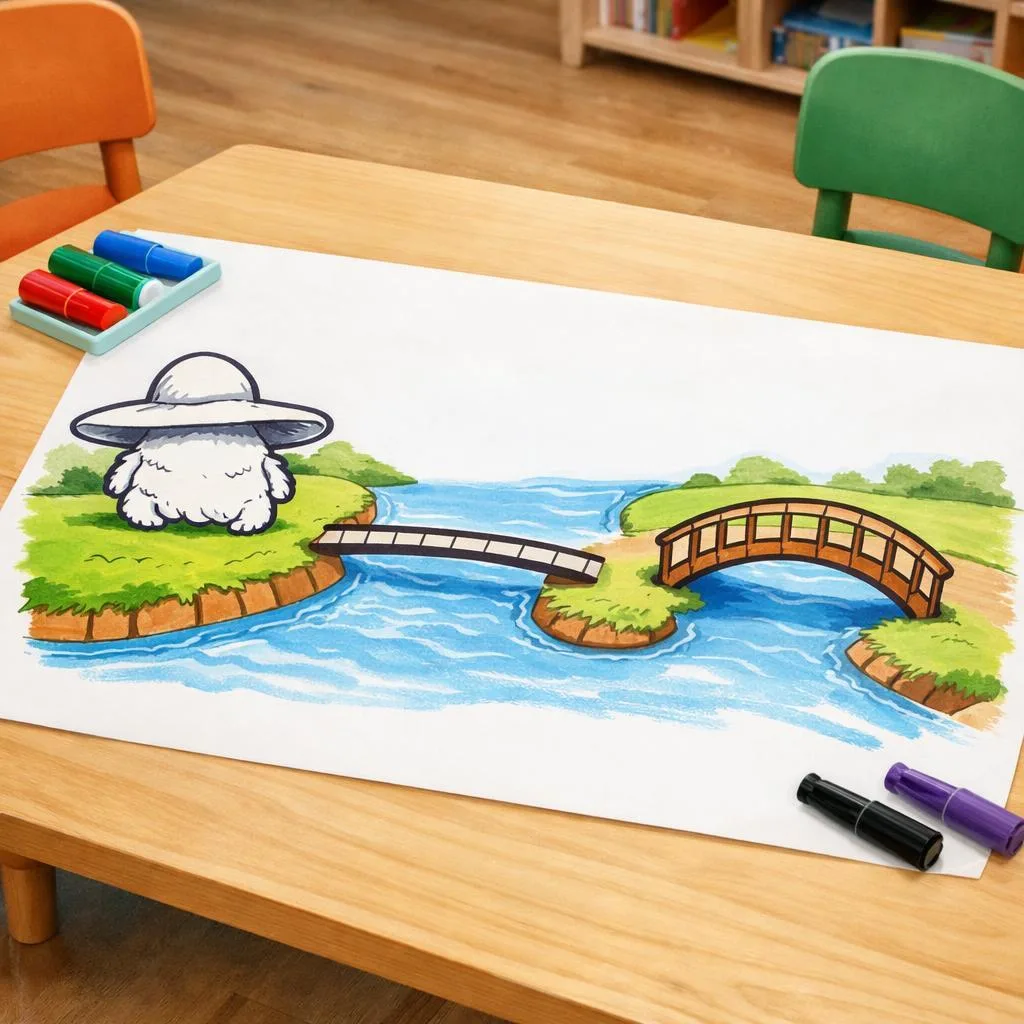

A 20-minute collaborative drawing adventure for ages 3–5. Children imagine a visitor who needs a bridge, compare widths, and help redesign a shared picture through words, pointing, signs or gestures.


Prepare the picture (2 minutes). Invite 4–6 children to gather around the table. Draw two riverbanks and a river between them. Explain that this is a pretend design adventure: nobody will climb onto furniture or try to cross a real bridge. Children may watch before joining.
Invent the visitor (3 minutes). Ask, 'Who might want to visit the other side?' Invite a few ideas, then combine willing children's suggestions into one imaginary visitor, such as a fluffy creature with a very wide hat. Draw a simple outline on one riverbank. Children may describe, point, gesture or ask the educator to offer two choices.
Meet the bridge problem (3 minutes). Draw a bridge across the river using two parallel lines that are clearly closer together than the visitor's width. Say, 'Our visitor wants to cross without squeezing. What do you notice about this bridge?' Give children time to look and respond. Ask, 'What could we change?' rather than supplying a solution immediately.
Try a redesign (4 minutes). Follow a child's suggestion by drawing a new bridge elsewhere on the same river. If the idea is to make it wider, draw its sides farther apart. Use your fingers to indicate the visitor's width and compare it with the space between the bridge's sides. Ask, 'What makes you think this one has enough room?' Treat the drawing as a pretend comparison, not a test of real bridge strength.
Offer different entry points (3 minutes). For children around age 3 or new to comparisons, point to two clearly different bridges and ask which has more room across. Model the words 'wider' and 'narrower' without requiring repetition. For children around ages 4–5 who want more challenge, add a second visitor with a different width and ask whether one bridge could suit both. Choose the challenge by interest and readiness, not age alone.
Tell the crossing story (3 minutes). Invite children to decide what happens when the visitor reaches the other bank. Narrate their ideas while tracing the route with your finger. Each child can contribute a word, sign, sound, gesture or silent point, or pass. Keep the paper within view and bring it closer when needed rather than asking children to reach across one another.
Reflect and finish (2 minutes). Ask, 'What did we change to help our visitor?' Recap one or two ideas using the children's contributions. Afterward, privately note examples of comparing widths, proposing changes or communicating a choice to guide future play. Do not rank children or treat participation as a developmental assessment.


A 15-minute shared drawing adventure for ages 3–5. Children invent a make-believe place, help locate its landmarks, and tell a tiny journey using words, gestures, or supported choices.
A 15-minute pretend-play activity for ages 3–5. Children invent welcoming invitations for imaginary guests, choosing words, gestures and playful changes that help everyone join.
A 15-minute pretend weather studio for ages 3–5. Children invent forecasts for imaginary characters, explore feeling words and choose caring responses through speech, pointing or gentle gestures.
A 15-minute pretend-play activity for ages 3–5. Children imagine different uses for one blanket, help an imaginary character solve a problem, and build a short shared story through words, gestures or choices.