
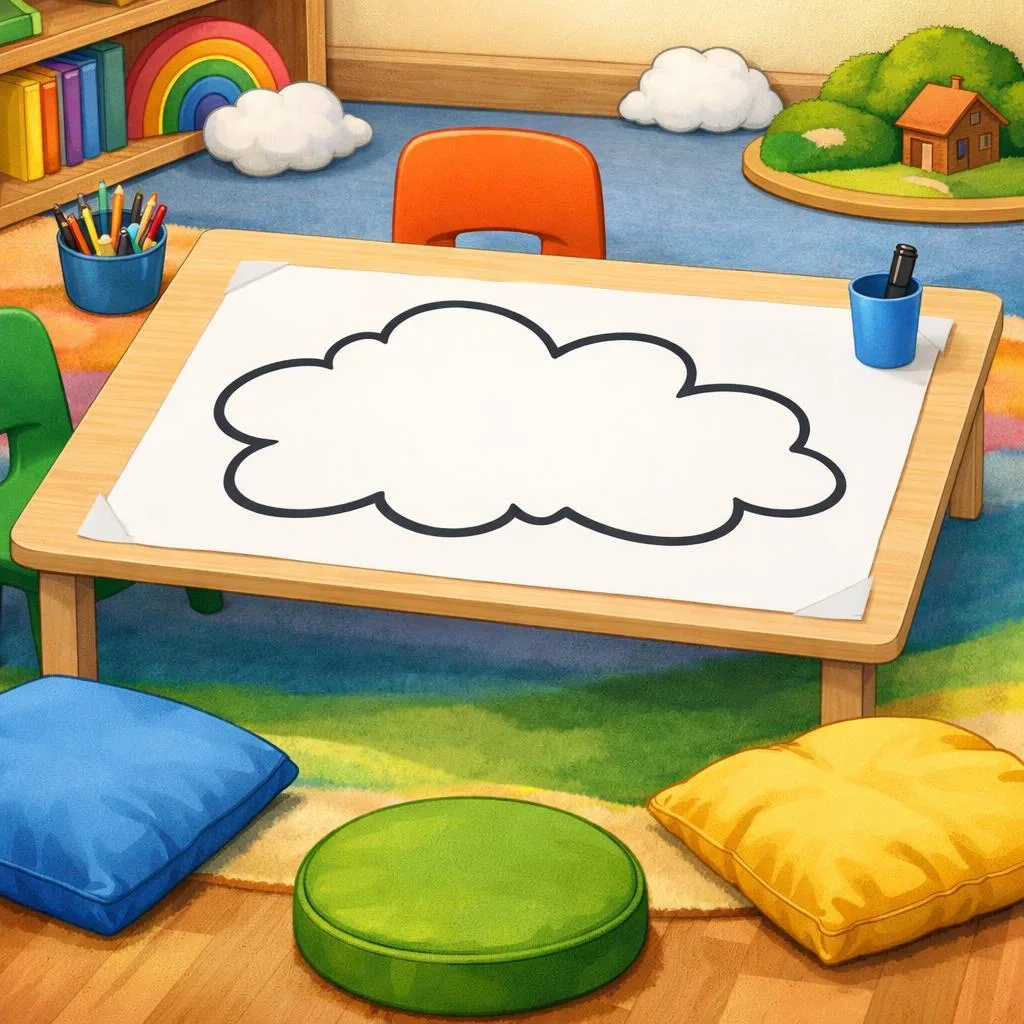

A 15-minute collaborative drawing and storytelling game for ages 3–5. Children imagine what a cloud could become, add ideas to a shared picture, and explore how one drawing can inspire many stories.


Prepare the cloud (2 minutes). Invite 4–6 children to gather where everyone can see the paper comfortably. Draw a large, simple, irregular outline. Say, 'Our pretend cloud has forgotten what shape it wants to be. What could it become?' Explain that children can offer ideas, point, watch or pass.
Wonder together (3 minutes). Give children quiet thinking time before inviting responses. Accept different ideas without choosing a correct answer. If a child needs a starting point, ask, 'Could it be something that moves, or somewhere to rest?' Describe the outline aloud and trace its direction with your finger for children who benefit from additional visual explanation.
Let the cloud change (3 minutes). Invite one child to suggest a feature for the educator to draw, such as a doorway, a tail or a long curved line. Ask where it should go, accepting pointing, gaze direction, gestures or words. Add the feature, then ask, 'What could our cloud be now?' Welcome new interpretations, even when they differ from earlier ones.
Choose a comfortable challenge (3 minutes). For children around age 3 or new to shared storytelling, invite one feature or one action and model a short phrase: 'The cloud has a door.' For children around ages 4–5 who want more challenge, ask them to connect two ideas: 'It has a door. Who might visit, and what happens next?' Follow readiness and interest rather than age alone. Repeat each contribution neutrally and leave time for others to respond.
Tell the cloud's little adventure (2 minutes). Retell two or three child-selected ideas as a brief pretend story while pointing to the drawing. Invite children to supply a word, gesture or action for the character. Ask, 'How shall our story end?' Offer two spoken possibilities if open-ended choices feel difficult, while welcoming another suggestion.
Close and notice (2 minutes). Ask, 'Did anyone imagine something different when we added a new line?' Make room for several answers or a quiet look at the drawing. Thank the group for sharing different possibilities. Afterward, note how children contributed and what support helped them participate; use this to plan another playful session.
Adapt for your group. Keep all participation seated if preferred and place the paper within a comfortable viewing range. Use bold lines and describe every added feature aloud. Accept communication devices, signs and gestures, and let children direct an adult or partner without drawing themselves. Offer a quieter small-group version or an individual preview. Children may watch throughout without being required to speak or take a turn.


A 15-minute pretend-play activity for ages 3–5. Children invent welcoming invitations for imaginary guests, choosing words, gestures and playful changes that help everyone join.

A 15-minute pretend weather studio for ages 3–5. Children invent forecasts for imaginary characters, explore feeling words and choose caring responses through speech, pointing or gentle gestures.

A 15-minute pretend-play activity for ages 3–5. Children imagine different uses for one blanket, help an imaginary character solve a problem, and build a short shared story through words, gestures or choices.
A 15-minute shared drawing adventure for ages 3–5. Children invent a make-believe place, help locate its landmarks, and tell a tiny journey using words, gestures, or supported choices.