
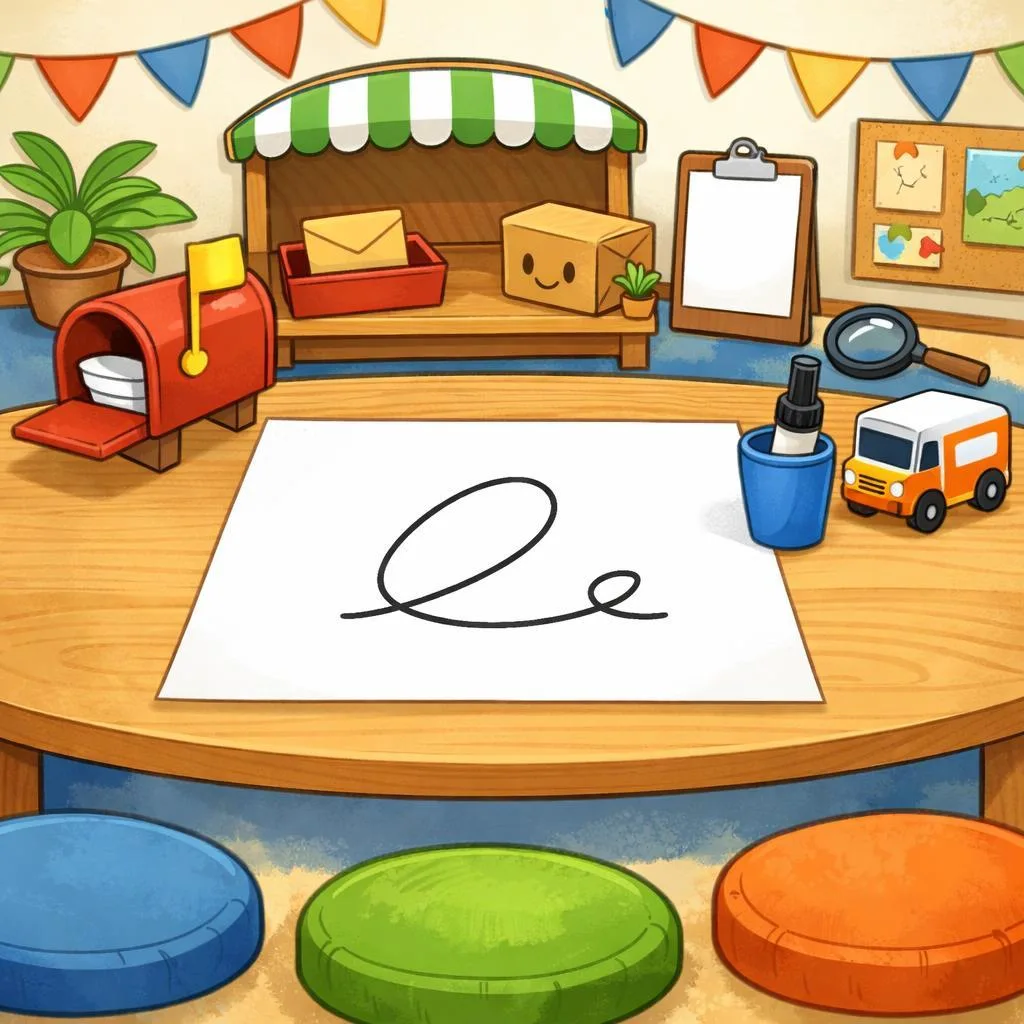

A 15-minute pretend-play activity for ages 3–5. Children help turn a mysterious doodle into a picture message, then choose how to explain and deliver it without leaving their seats.


Open the delivery desk (2 minutes). Invite a small group to sit comfortably around a clear table or drawing surface. Explain: 'Our pretend delivery desk makes picture messages. Today, a doodle needs our help becoming a message!' Children may participate, watch or pass; nobody needs to move around the room.
Meet the mystery doodle (2 minutes). Draw one large curved line with a loop on fresh paper. Ask, 'What could this become?' Wait quietly for responses. Accept pointing, gestures, communication-aid selections or spoken ideas. Describe the line aloud for children who cannot easily see it. Treat different interpretations as possibilities rather than right or wrong answers.
Choose a message (3 minutes). Invite the children to imagine someone who might receive the picture, such as a pretend gardener or a friendly giant. Ask, 'What might we want to tell them?' Follow the group's interests. If the question feels too broad, offer two concrete choices: 'Could this show a place to rest, or something to look at?' Confirm each child's intended meaning rather than guessing from a gesture.
Make the picture together (3 minutes). Add two or three large details suggested by the children. Narrate each addition: 'You chose a roof, so I am drawing it above the curve.' Ask what else the recipient would need to understand the message. Write a short child-dictated sentence beneath the drawing and read it back, pointing to the words. Explain that the picture and writing can both carry meaning.
Deliver it through pretend play (3 minutes). Hold up the finished message and invite children to explain it to the imaginary recipient. Beginners can point to one detail or choose between two descriptions. Children ready for more can give a full message or explain why a detail helps. Model the recipient asking, 'What does this part mean?' A child may answer, ask the educator to speak for them, or pass. Deliver the message simply by turning the paper toward an imaginary visitor.
Close the desk (2 minutes). Read back the group's message and ask, 'What helped us share our idea?' Briefly revisit one picture detail and the written sentence. Thank children for contributing different ideas. Afterward, note whether children selected a detail, communicated a meaning or extended someone else's suggestion; use this to plan another playful invitation rather than to score performance.
Adjust access and challenge throughout. Choose the level by readiness, not age alone. Start with one familiar picture detail and two choices; progress to a complete message or a recipient's follow-up question. Keep drawings bold and uncluttered, describe changes aloud, position paper within comfortable viewing range and allow extra response time. Accept any familiar communication method. If drawing is not accessible or appealing, co-create the message orally while the educator describes an imaginary picture. Keep the pace gentle and finish early if interest fades.


A 15-minute pretend-play activity for ages 3–5. Children invent welcoming invitations for imaginary guests, choosing words, gestures and playful changes that help everyone join.
A 15-minute pretend weather studio for ages 3–5. Children invent forecasts for imaginary characters, explore feeling words and choose caring responses through speech, pointing or gentle gestures.
A 15-minute pretend-play activity for ages 3–5. Children imagine different uses for one blanket, help an imaginary character solve a problem, and build a short shared story through words, gestures or choices.
A 15-minute shared drawing adventure for ages 3–5. Children invent a make-believe place, help locate its landmarks, and tell a tiny journey using words, gestures, or supported choices.