
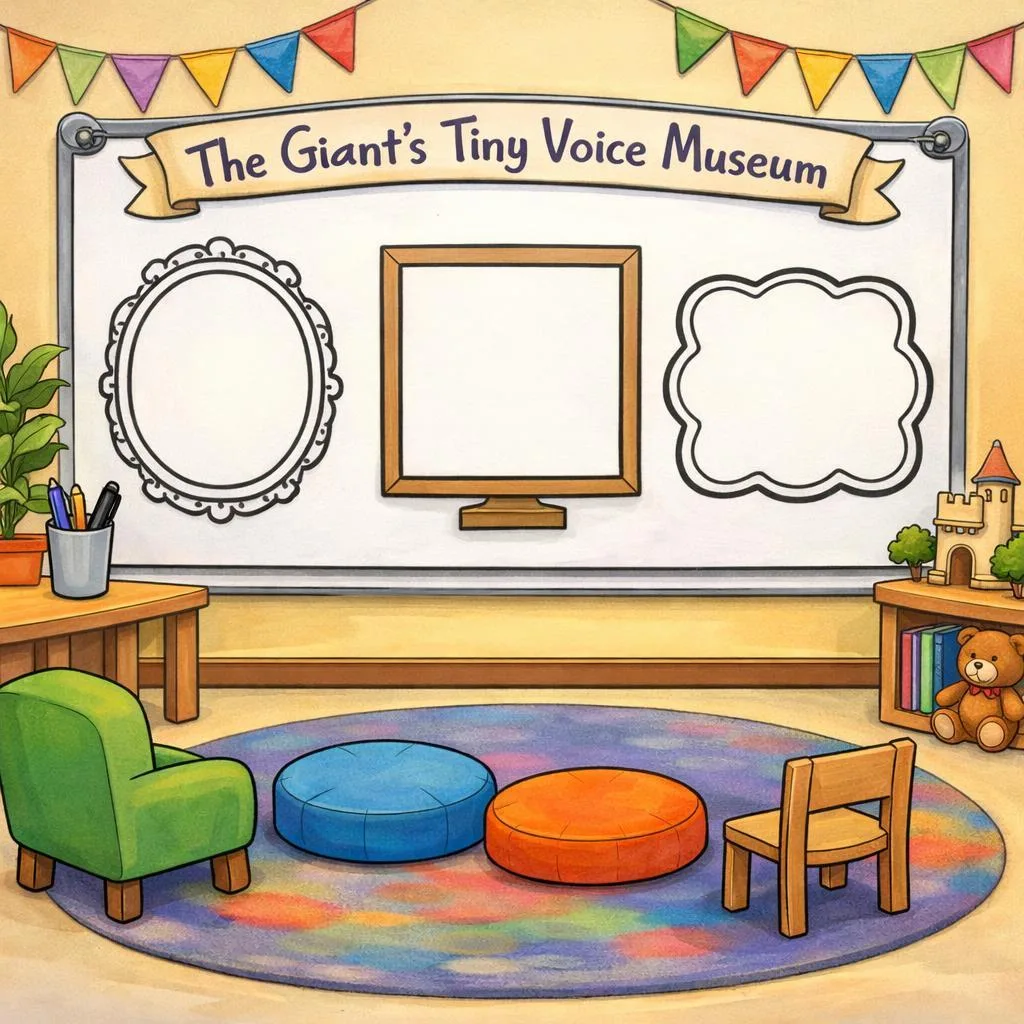

A 15-minute pretend-play activity for ages 3–5. Children invent imaginary museum exhibits, describe their features and help a friendly giant learn how to listen, with drawing, pointing and silent participation welcome.


Prepare the museum (2 minutes). Invite a small group to sit comfortably where everyone can see the paper. Draw three large, empty display frames. Explain that this museum holds imaginary things, so nothing needs to be brought or carried. Children may speak, point, gesture, watch or ask you to draw for them.
Meet the visitor (2 minutes). Pretend to be a friendly giant who wants to visit but does not know how to listen. Use a comfortable conversational voice, not a shout or forced whisper. Ask, 'What could help our giant notice everyone's ideas?' Model waiting, looking toward a speaker without requiring eye contact, and allowing quiet thinking time.
Invent the first exhibit (3 minutes). Suggest a playful possibility, such as a pillow that stores giggles, then invite children to invent something different. Ask, 'What might belong in our museum?' Wait for responses. Sketch children's ideas simply inside a frame and repeat their descriptions without changing their meaning. Offer two spoken choices if an open question feels too broad.
Explore and describe (3 minutes). Invite children to tell or show one feature of an exhibit: its shape, texture, sound or job. For children around age 3 or new to the activity, accept a gesture or one descriptive word and model a short phrase. For children around ages 4–5 who want more challenge, ask how the exhibit works or why a visitor might enjoy it. Choose the level by interest and readiness, not age alone.
Give the giant a tour (3 minutes). Invite volunteers to introduce an exhibit. A child can speak with a partner, point while you describe, use their usual communication aid or pass. As the giant, ask one curious question, such as, 'How would I know when it is working?' Leave time to respond and welcome different answers rather than searching for one correct idea.
Close the museum (2 minutes). Ask, 'What helped us understand each other's exhibits?' Summarize a few contributions and thank children for sharing or listening. Afterward, note examples of describing, communicating a choice or building on another person's idea to guide future invitations, without ranking children.
Adapt for access and interest. Keep all participation seated if preferred and bring the drawing into each child's comfortable viewing range. Describe each sketch aloud and use bold, uncluttered lines. Accept gestures and communication aids equally with speech. Keep the giant character optional for anyone who finds it unsettling; the educator can simply be a curious museum visitor. Children may change an exhibit or finish early if interest fades.


A 15-minute pretend-play activity for ages 3–5. Children invent welcoming invitations for imaginary guests, choosing words, gestures and playful changes that help everyone join.
A 15-minute pretend weather studio for ages 3–5. Children invent forecasts for imaginary characters, explore feeling words and choose caring responses through speech, pointing or gentle gestures.
A 15-minute pretend-play activity for ages 3–5. Children imagine different uses for one blanket, help an imaginary character solve a problem, and build a short shared story through words, gestures or choices.
A 15-minute pretend-play activity for ages 3–5. Children invent helpful imaginary machines, explain what they do, and work together to improve a shared invention using words, gestures or drawings.