
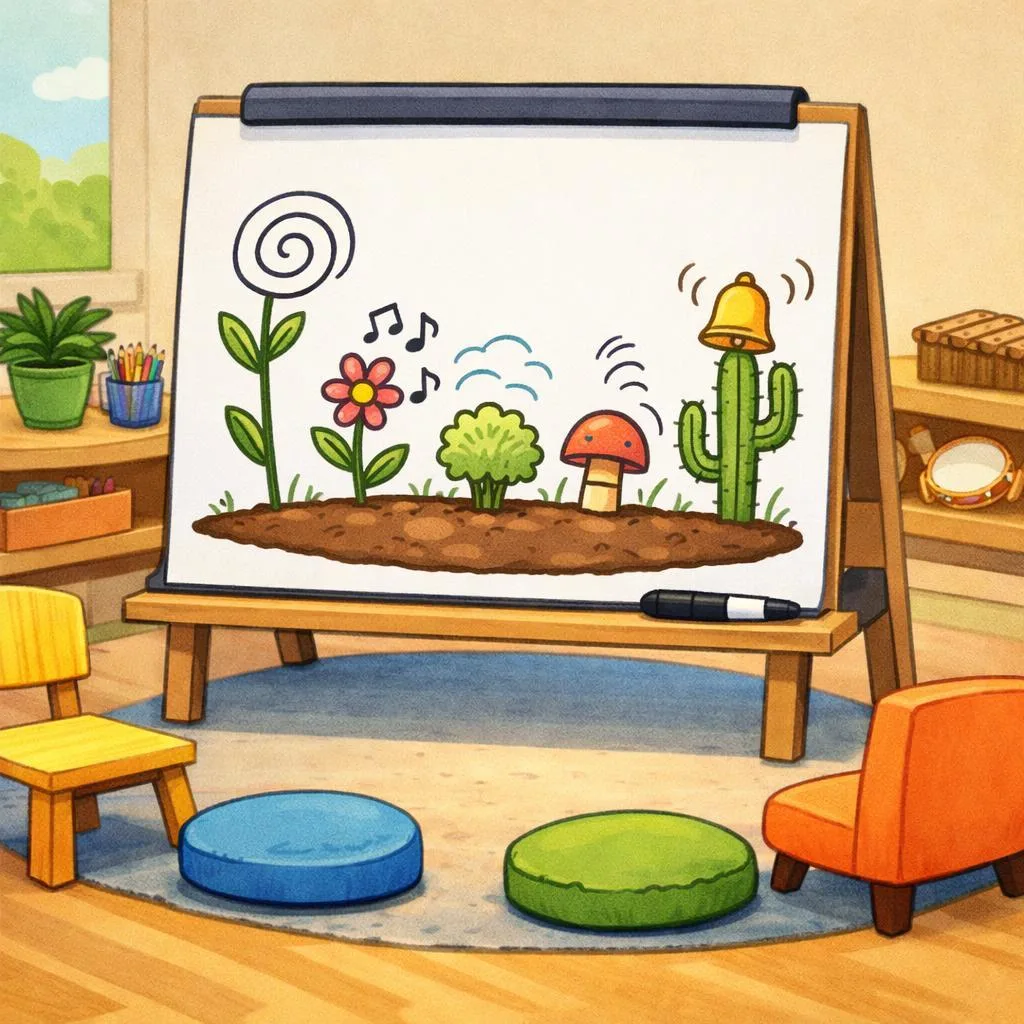

A 15-minute activity for ages 3–5 in which children invent imaginary plants and decide what sounds or silent gestures they make. Children help grow a shared garden story through choices, turn-taking and playful descriptions.


Prepare the garden (2 minutes). Invite a small group to sit comfortably where everyone can see the paper. Draw a broad garden bed. Explain, 'This is a pretend garden. Its plants can make sounds—or stay completely silent!' Let children know they can contribute, watch or pass.
Introduce a surprising plant (2 minutes). Draw a simple tall stem with a large spiral on top. Say, 'My pretend plant makes a soft whoosh when a cloud goes past.' Model a quiet whoosh and a small hand wave as equally welcome ways to represent it. Keep all sounds at a comfortable conversational volume.
Invent together (4 minutes). Invite each interested child to suggest a plant, its sound or its gesture. Ask one question at a time, such as 'What could grow here?' or 'What happens when it wakes up?' Pause for responses. Draw each idea simply and describe what you understood, allowing the child to confirm or change it. If a child wants help, offer two clear choices without requiring speech.
Build a garden story (3 minutes). Point to two or three drawings and begin, 'One morning, our garden woke up.' Invite children to supply what happens next. Connect their contributions in a brief story: one plant might hum, another might wave, and another might rest. Ask, 'How could these plants say hello to each other?' Accept different possibilities rather than looking for one correct answer.
Offer a comfortable next challenge (2 minutes). For children new to the activity, often around age 3, invite one sound, gesture or choice while you provide the story words. For children ready for more, often around ages 4–5, invite a short description or an event with a reason: 'The plant whispers because…' Let readiness and interest guide the challenge; children can stay with the simpler option.
Close the garden (2 minutes). Retell the short story while pointing to the drawings. Invite children to join with their chosen sound, gesture or quiet watching. Ask, 'What should our garden do now?' End with a shared imaginary rest. Afterward, note examples of communicating a choice, adding an idea or responding to a peer to guide future play.
Adapt throughout. Keep the whole activity seated and bring the drawing into a comfortable viewing position. Describe drawings aloud. Accept communication devices, signs, gestures and words in any language. For children who prefer no sound, make the entire garden silent and narrate their chosen movements. Give extra response time, offer a partner contribution and shorten the session if interest fades. No child needs to imitate a sound or movement to participate.


A 15-minute pretend-play activity for ages 3–5. Children invent welcoming invitations for imaginary guests, choosing words, gestures and playful changes that help everyone join.

A 15-minute pretend weather studio for ages 3–5. Children invent forecasts for imaginary characters, explore feeling words and choose caring responses through speech, pointing or gentle gestures.

A 15-minute pretend-play activity for ages 3–5. Children imagine different uses for one blanket, help an imaginary character solve a problem, and build a short shared story through words, gestures or choices.

A 15-minute pretend-play activity for ages 3–5. Children invent helpful imaginary machines, explain what they do, and work together to improve a shared invention using words, gestures or drawings.