
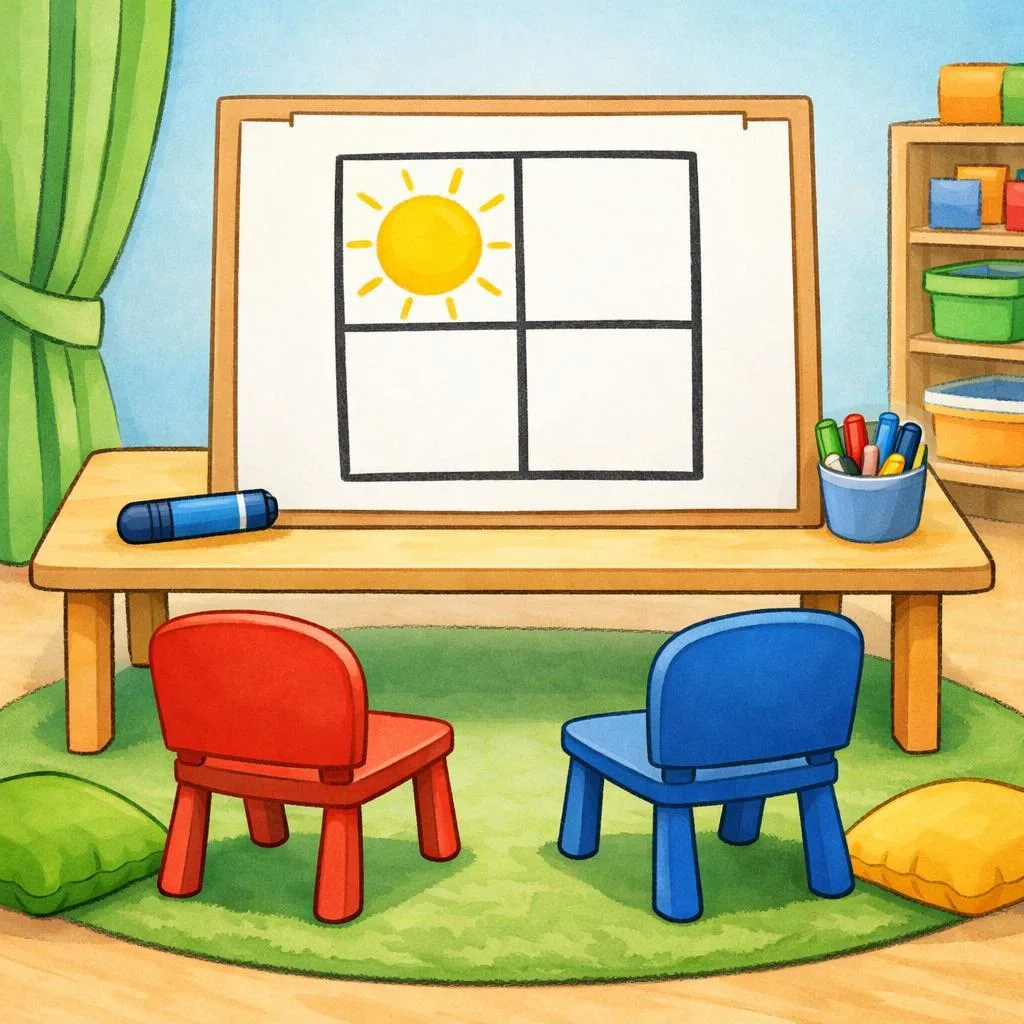

A 15-minute pretend-play activity for ages 3–5. Children invent weather for an imaginary window, suggest what a story character might do, and explore how different choices can work.


Prepare the window (2 minutes). Place the paper where everyone can see it without reaching or crowding. Invite a small group to sit comfortably. Explain that this is a pretend window whose weather can change when someone shares an idea. Children may participate by speaking, pointing, making a comfortable gesture or watching.
Discover the first weather (2 minutes). Draw a large sun outside the window outline. Introduce an imaginary character: 'Our visitor wants to spend some time outside. What do they notice through the window?' Allow thinking time. Describe children's contributions without requiring a particular answer.
Make a choice (3 minutes). Ask, 'What might our visitor do next?' Accept ideas such as finding shade, wearing a hat or staying inside to draw. Sketch one or two suggestions. Invite children to explain or show their thinking, but do not require explanations. Emphasize that a story can have several possible choices.
Mix up the view (3 minutes). Invite a child to choose new pretend weather. Offer two spoken options, such as rain or wind, if an open choice feels too broad. Draw their choice and ask, 'What changed? What could our visitor do now?' Children can suggest an action for the educator to mime gently while seated. No running, climbing or acting out hazardous weather is needed.
Build a tiny weather adventure (3 minutes). Adjust the challenge to readiness rather than age alone. For younger children or beginners, use one weather change and model a short phrase such as 'Rain outside; read inside.' For children ready for more, link two changes using 'first' and 'then,' or invite two different endings. A child may direct the story through pointing while the educator supplies the words. Follow children's interests rather than requiring everyone to lead.
Close the window (2 minutes). Retell the group's short story while pointing to the drawings. Ask, 'Which choice would you like for our visitor?' Accept different preferences and allow children to pass. Afterward, note examples of describing, making connections or adding story ideas to guide future play, not to score children.
Adapt throughout. Keep drawings large and uncluttered, and describe each addition aloud. For children who cannot easily see the drawing, narrate the choices and repeat peers' contributions. Accept communication devices, signs and gestures; offer to voice a child's indicated choice. Avoid unexpected weather noises. If pretend weather feels uncomfortable, switch to a window overlooking an imaginary garden and choose what the visitor notices there.


A 15-minute pretend-play activity for ages 3–5. Children invent welcoming invitations for imaginary guests, choosing words, gestures and playful changes that help everyone join.

A 15-minute pretend weather studio for ages 3–5. Children invent forecasts for imaginary characters, explore feeling words and choose caring responses through speech, pointing or gentle gestures.

A 15-minute pretend-play activity for ages 3–5. Children imagine different uses for one blanket, help an imaginary character solve a problem, and build a short shared story through words, gestures or choices.
A 15-minute shared drawing adventure for ages 3–5. Children invent a make-believe place, help locate its landmarks, and tell a tiny journey using words, gestures, or supported choices.