
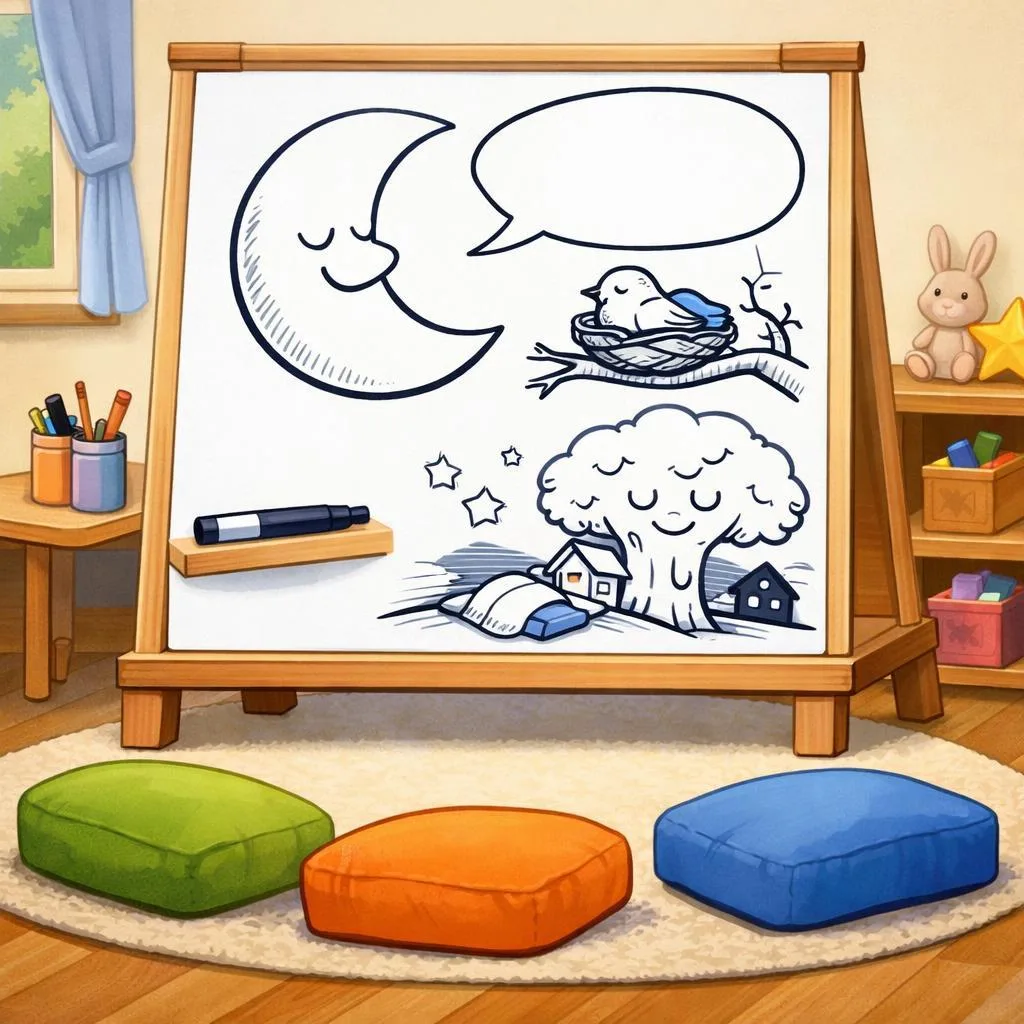

A 15-minute storytelling game for ages 3–5. Children help a pretend moon invent a goodnight message, choosing characters, solving a gentle story problem and sharing ideas through words, gestures or pictures.


Prepare the moon (2 minutes). Gather a small group around the paper. Draw a large moon with an empty speech bubble. Say, 'Our pretend moon wants to say goodnight, but cannot decide what message to send. Shall we help?' Explain that children may contribute, watch or pass. Keep the marker with the educator and the floor clear.
Choose a listener (2 minutes). Ask, 'Who might be awake to hear the moon?' Wait for ideas. If a choice would help, offer two possibilities, such as a resting bird or a sleepy tree. Children can speak, gesture or point as you sketch the options. Select one together, acknowledging that other ideas can appear in another story.
Begin the story (3 minutes). Say, 'One evening, the moon saw our listener getting ready to rest.' Invite children to suggest where the listener is and what might help them feel comfortable. Draw one or two large details. Restate contributions without requiring children to repeat your words. Avoid assuming that everyone has the same bedtime routines.
Solve a gentle problem (3 minutes). Explain, 'The moon's message is not ready yet. What could it say or show?' Accept invented words, a friendly face, a wave or a short sentence. Ask, 'How might our listener answer?' Give children time to respond. Combine compatible ideas, or tell two brief versions when children prefer different endings.
Retell at a comfortable level (3 minutes). For children beginning to join shared stories, point to the moon and listener and invite one choice or gesture while you narrate. For children ready for more, invite them to explain what happened first, describe the message or invent the reply. Use readiness rather than age alone. Children may direct the educator instead of performing, and no one needs to speak alone.
Close the story (2 minutes). Retell the group's beginning, problem and ending while pointing to the drawing. Ask, 'What helped our moon finish its message?' Welcome words, pointing, gestures or quiet listening. Afterward, note examples of choosing, contributing and connecting story events to guide future invitations, not to score children.
Adapt throughout. Keep the drawing within comfortable viewing and pointing range. Describe each drawing aloud and use large, high-contrast shapes. Offer spoken choices for children who cannot easily see or point, and accept eye gaze, signs or existing communication supports. Keep the room normally lit; no darkness, sound effects or movement are required. Shorten the story if interest fades.


A 15-minute pretend-play activity for ages 3–5. Children invent welcoming invitations for imaginary guests, choosing words, gestures and playful changes that help everyone join.

A 15-minute pretend weather studio for ages 3–5. Children invent forecasts for imaginary characters, explore feeling words and choose caring responses through speech, pointing or gentle gestures.

A 15-minute pretend-play activity for ages 3–5. Children imagine different uses for one blanket, help an imaginary character solve a problem, and build a short shared story through words, gestures or choices.

A 15-minute pretend-play activity for ages 3–5. Children invent helpful imaginary machines, explain what they do, and work together to improve a shared invention using words, gestures or drawings.