
 15 min
The Scribble Creature Needs a Home
A 15-minute collaborative drawing adventure for ages 3–5. Children turn a teacher-drawn scribble into an imaginary creature, then invent a welcoming home using words, gestures and shared choices.


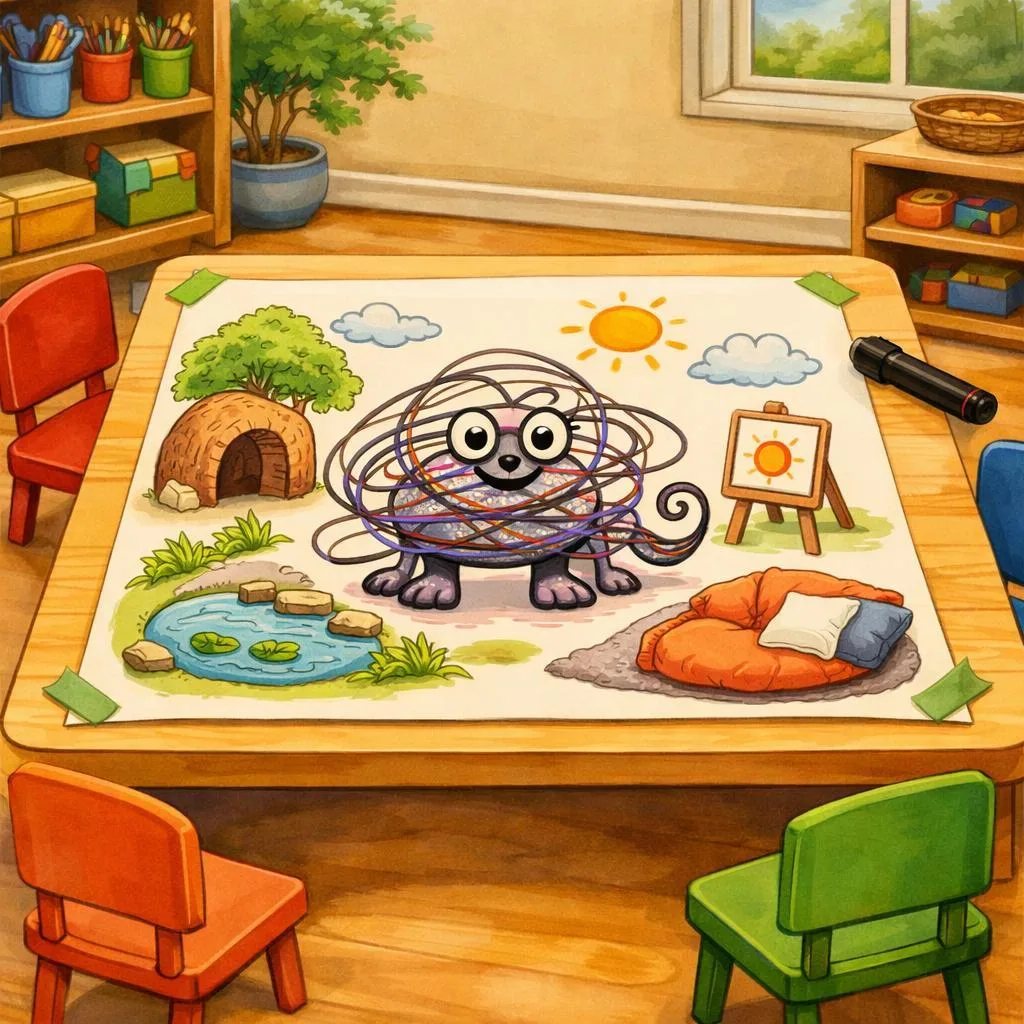
Prepare the invitation (2 minutes). Gather 4–6 children around the paper, leaving clear access for seated participants. Explain that you will draw their ideas and that children may contribute, watch or pass. Make one large looping scribble and say, 'Something imaginary might live inside these lines. What could it be?'
Meet the creature (3 minutes). Give children time to look before inviting ideas. Accept a word, sound, gesture, sign or description. Ask permission before adding a suggested feature, such as wide feet or a curly tail. If ideas differ, suggest combining them or giving the creature an imaginary neighbor. Let the children choose a name, or leave it unnamed.
Wonder about its needs (3 minutes). Ask, 'Where might our creature feel comfortable?' Follow children's interests with one question at a time: 'Where could it rest?' or 'What might help when it wants quiet?' Restate an idea and pause for children to add to it. Treat answers as possibilities rather than looking for one correct home.
Draw a welcoming home (3 minutes). Sketch two or three large features suggested by the group, such as a shaded resting spot, a wide entrance or a place to make art. For beginners, offer two spoken choices and point to the relevant areas of the drawing. For children ready for more, ask them to explain how a feature helps the creature or suggest another way to meet the same need. Choose the challenge by readiness rather than age alone.
Tell a tiny shared story (2 minutes). Point to the drawing and begin, 'Our creature arrived at its new home and noticed...' Invite children to supply a word, gesture or short event. Weave their contributions into a brief story. A child may direct the educator by looking toward or pointing to a feature instead of speaking.
Close and reflect (2 minutes). Retell the group's story in a few sentences. Ask, 'What did we add to help our creature feel welcome?' Acknowledge specific contributions without ranking them. Afterward, note how children communicated choices, connected ideas or responded to a peer, and use those observations to plan another playful invitation.
Adapt throughout. Describe each new mark aloud and keep the drawing large and uncluttered. Bring the paper into each child's comfortable viewing range as needed. Offer verbal choices without requiring sight or pointing, and accept a child's usual communication method. Keep the room quiet, allow extra response time and offer a one-to-one retelling later. Children may imagine features while the educator does all drawing; no grasping or standing is required.


A 15-minute pretend-play activity for ages 3–5. Children invent welcoming invitations for imaginary guests, choosing words, gestures and playful changes that help everyone join.

A 15-minute pretend weather studio for ages 3–5. Children invent forecasts for imaginary characters, explore feeling words and choose caring responses through speech, pointing or gentle gestures.

A 15-minute pretend-play activity for ages 3–5. Children imagine different uses for one blanket, help an imaginary character solve a problem, and build a short shared story through words, gestures or choices.

A 15-minute pretend-play activity for ages 3–5. Children invent helpful imaginary machines, explain what they do, and work together to improve a shared invention using words, gestures or drawings.