
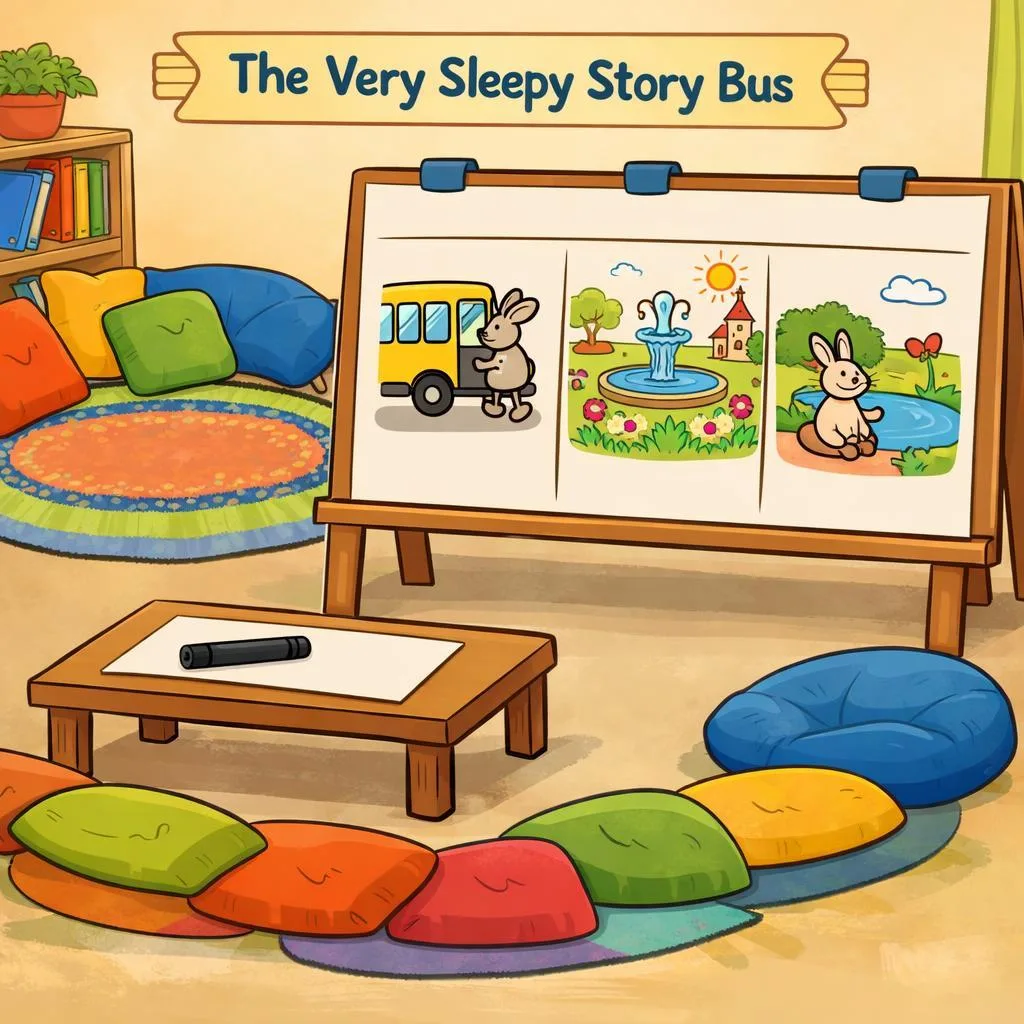

A 15-minute pretend-play adventure for ages 3–5. Children invent passengers and destinations for an imaginary bus, then help tell what happens first, next and last. Everyone can participate through words, gestures, pointing or watching.


Welcome passengers (2 minutes). Invite a small group to sit comfortably in their usual seats or on the floor. Explain that the bus is imaginary: nobody needs to move seats, climb or travel around the room. Say, 'Our story bus is very sleepy. What gentle way could we wake it?' Invite a quiet greeting, a small wave or simply watching. Avoid sudden loud sounds.
Invent a passenger (3 minutes). Model one possibility: 'A rabbit with enormous slippers is waiting for the bus.' Invite children to suggest another imaginary passenger. Offer two spoken choices if helpful, such as an animal or a pretend person. Children may speak, gesture, use their communication system or ask you to contribute for them. Pause long enough for responses and accept passing.
Choose a destination (3 minutes). Ask, 'Where might our passengers want to go?' Follow the children's interests, whether they suggest a familiar place or an imaginary one. Help the group combine ideas rather than requiring a vote: a garden could have a singing fountain. Draw a simple, large picture of the chosen destination and describe it aloud. Ask, 'What might we notice there?' There is no single correct answer.
Build the tiny journey (3 minutes). Divide the paper into three large spaces and narrate as you sketch: 'First, our passenger gets on. Next, the bus reaches our special place. Last, something happens there.' Invite children to decide the ending. For children new to storytelling, offer a choice between two endings and retell alongside them. For children ready for more, ask why the passenger wanted to visit or how another character could help. Choose the challenge by interest and readiness, not age alone.
Tell it together (2 minutes). Point to each picture while slowly retelling the group's story. Invite children to supply a word, gesture or idea, without requiring everyone to perform. A child may direct the educator to point rather than pointing themselves. Describe the pictures aloud so participation does not depend on seeing them. If ideas change, acknowledge the new possibility and save it for another journey.
Park and reflect (2 minutes). Say, 'Our bus is resting now.' Ask, 'What happened first?' or 'What part would you like to visit again?' Accept an answer in any available communication mode, or allow children to listen. Afterward, briefly note which supports helped children contribute and whether they connected story events. Use these observations to plan another playful session, not to score or compare children.
Adapt throughout. Keep the story to one passenger and one destination when fewer choices are helpful. Add a second passenger or a simple problem only when the group wants more. Welcome home-language contributions and acknowledge their meaning when known without requiring translation. Keep drawings bold and uncluttered, reduce background noise, and offer a quieter place nearby where a child can listen or rejoin. All pretend actions can remain verbal or use small, comfortable gestures.


A 15-minute pretend-play activity for ages 3–5. Children invent welcoming invitations for imaginary guests, choosing words, gestures and playful changes that help everyone join.

A 15-minute pretend weather studio for ages 3–5. Children invent forecasts for imaginary characters, explore feeling words and choose caring responses through speech, pointing or gentle gestures.

A 15-minute pretend-play activity for ages 3–5. Children imagine different uses for one blanket, help an imaginary character solve a problem, and build a short shared story through words, gestures or choices.

A 15-minute pretend-play activity for ages 3–5. Children invent helpful imaginary machines, explain what they do, and work together to improve a shared invention using words, gestures or drawings.