

 15 min
Clap, Tap, Repeat: A Preschool Pattern Circle
A 15-minute, no-print activity for ages 3–5. Children explore repeating patterns through gentle sounds and movements, with simple choices for beginners and a creative challenge for confident learners.


Set up the circle (2 minutes). Invite 4–6 children to sit or stand with comfortable space around them. Agree on a quiet stop signal: the educator raises an open hand and everyone pauses. Explain that watching first is also a way to join. Keep the floor clear; no small objects or loose props are needed.
Try two actions (2 minutes). Show one gentle clap, then one light tap on your own knees. Practise each action slowly. Offer silent alternatives, such as opening hands and touching shoulders, for children who prefer less sound. Choose movements each child can comfortably do while seated or standing.
Build a repeating pair (3 minutes). Perform clap–tap, clap–tap, clap–tap at a relaxed pace. Invite the children to copy. Stop after a clap and ask, 'What could come next in our repeating pair?' Accept an action, a gesture or words. Repeat the complete pair together rather than correcting a child in front of the group.
Choose the right level (3 minutes). For children around age 3 or new to patterns, stay with two actions and model alongside them. Pause after one full pair before repeating. For children around ages 4–5 who are comfortable, invite them to choose a different pair or try clap–clap–tap. Ask which small group of actions keeps returning. Use readiness, not age alone, to choose the challenge.
Let a child lead (3 minutes). Invite a volunteer to show a short pattern, then help the group repeat it twice. A child may lead with a partner, choose actions for the educator to perform, or pass. Keep patterns short enough to remember. If helpful, draw one large symbol for each action on paper held by the educator.
Close and observe (2 minutes). Ask, 'Which part did we repeat?' Invite a final shared pattern and finish with the stop signal. Afterward, note who copied with support, predicted the next action, or made a repeating unit. Use these observations to plan the next activity; this is playful practice, not a developmental test.
Adapt for your group. Use visual movements instead of sound, slow the pace, and allow extra processing time. Accept home-language words, signs and gestures. For a quiet follow-up, the educator can draw a circle–line–circle–line sequence and invite children to point to the next symbol. Offer another short session on a later day rather than extending the circle when interest fades.


A 15-minute shared drawing adventure for ages 3–5. Children invent a make-believe place, help locate its landmarks, and tell a tiny journey using words, gestures, or supported choices.
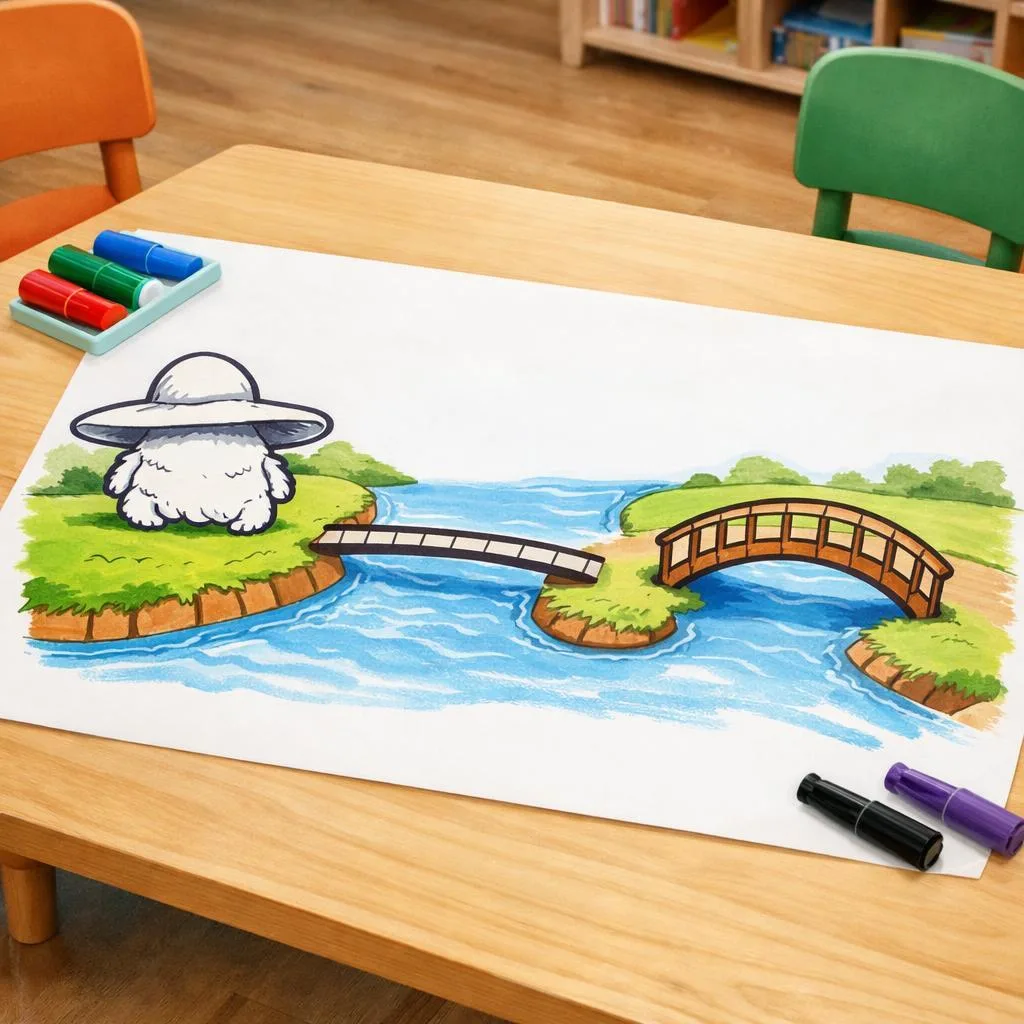
A 20-minute collaborative drawing adventure for ages 3–5. Children imagine a visitor who needs a bridge, compare widths, and help redesign a shared picture through words, pointing, signs or gestures.
A 15-minute pretend-play activity for ages 3–5. Children invent welcoming invitations for imaginary guests, choosing words, gestures and playful changes that help everyone join.
A 15-minute pretend weather studio for ages 3–5. Children invent forecasts for imaginary characters, explore feeling words and choose caring responses through speech, pointing or gentle gestures.